
Owl OpticsSecrets of Immortality
A Guide for Skeptics
Here we learn to see without the familiar light of knowledge about the world and ourselves, attuning a different mode of distinction. This book is about recognizing what is enduring in you — and remaining intact through any change.

PRE-ORDER
Owl Optics
Print · Audio
Order →
For Whom "Owl Optics" Is Intended
For Those Who Have Brushed Against the Edge of Their Known World
This is for those whose familiar maps have, at least once, stopped working. For those who discovered that success does not always bring fulfillment, and that loss is not always a defeat. For those who have tasted the strange space where old explanations dissolve and new ones have not yet been given form.
It is for those who have been touched by loss, illness, profound anxiety, betrayal, the death of a loved one, the collapse of carefully laid plans, or the sudden, vertiginous sense of being utterly lost — and who sensed that beneath these events lies something far deeper than mere circumstance.
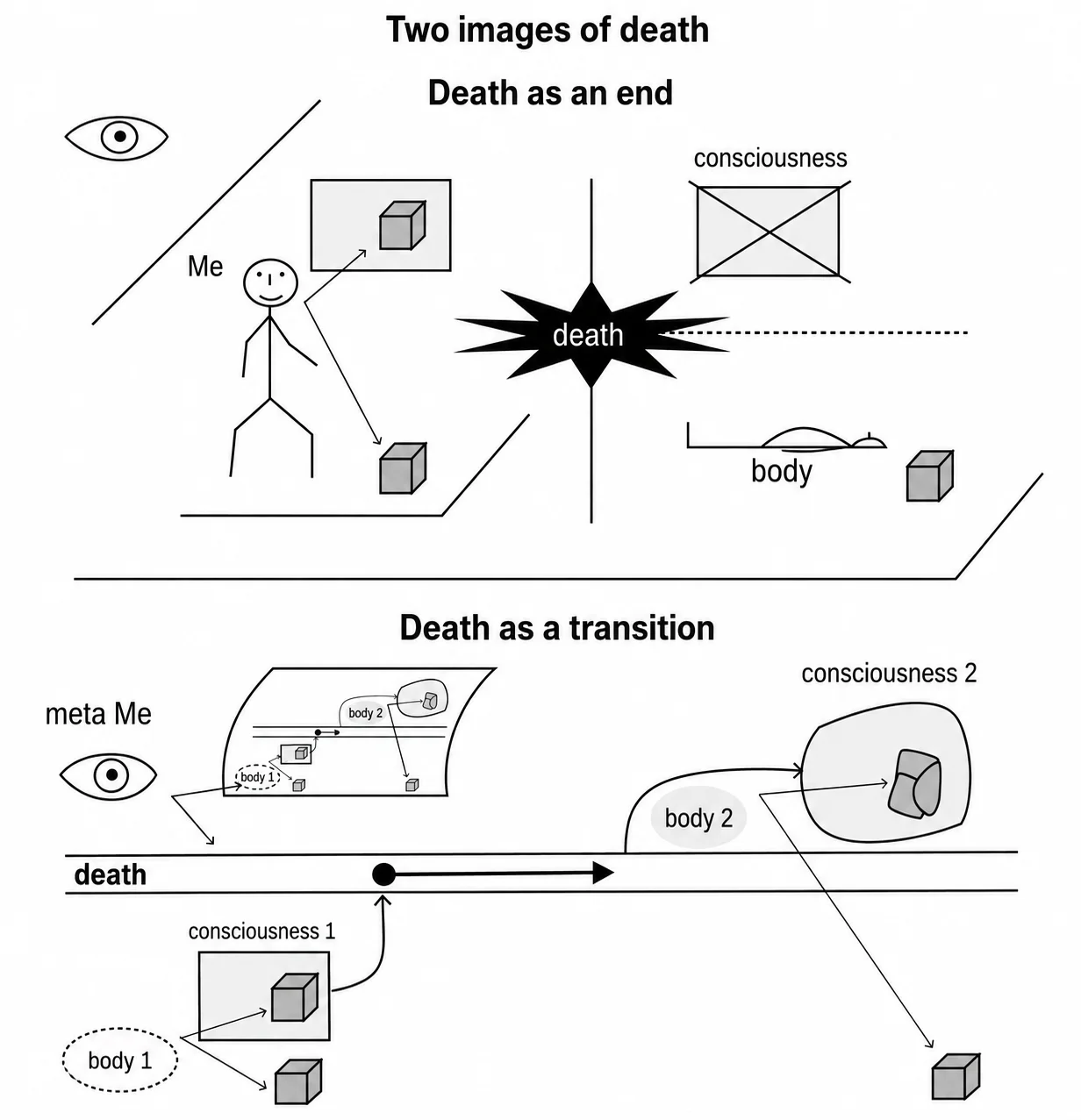
The Dichotomy of the Edge: Two Visions of Death
Death as an Ending
A horizontal cross-section of perception. Physical decline, the silent triumph of entropy, and the slow disintegration of the body's density. This is the vista of evolutionary fear—a protective shield for the biological form as long as consciousness is fused with its physical vessel.
Death as a Transition
The vertical dimension. A profound shift in the phase-state of consciousness, where inner coherence is maintained even as the external form collapses. The book investigates the mind's capacity to remain intact precisely at the threshold where its biological mediators fall silent.
Interdisciplinary Anatomy of Transformation
Dying is not an instantaneous blackout; it is a procedural unraveling. Contemporary clinical research records the phenomenon of the twilight of death.
At the moment of cardiac arrest, the temporo-parieto-occipital (TPO) junction of the brain exhibits powerful, highly coherent bursts of gamma rhythms. The brain does not descend into chaos—rather, it performs a final, peak integration of lived experience. Patients who return from this state often report architectonically ordered, hyper-meaningful memories, entirely refuting the hypothesis of a simple hypoxic hallucination.
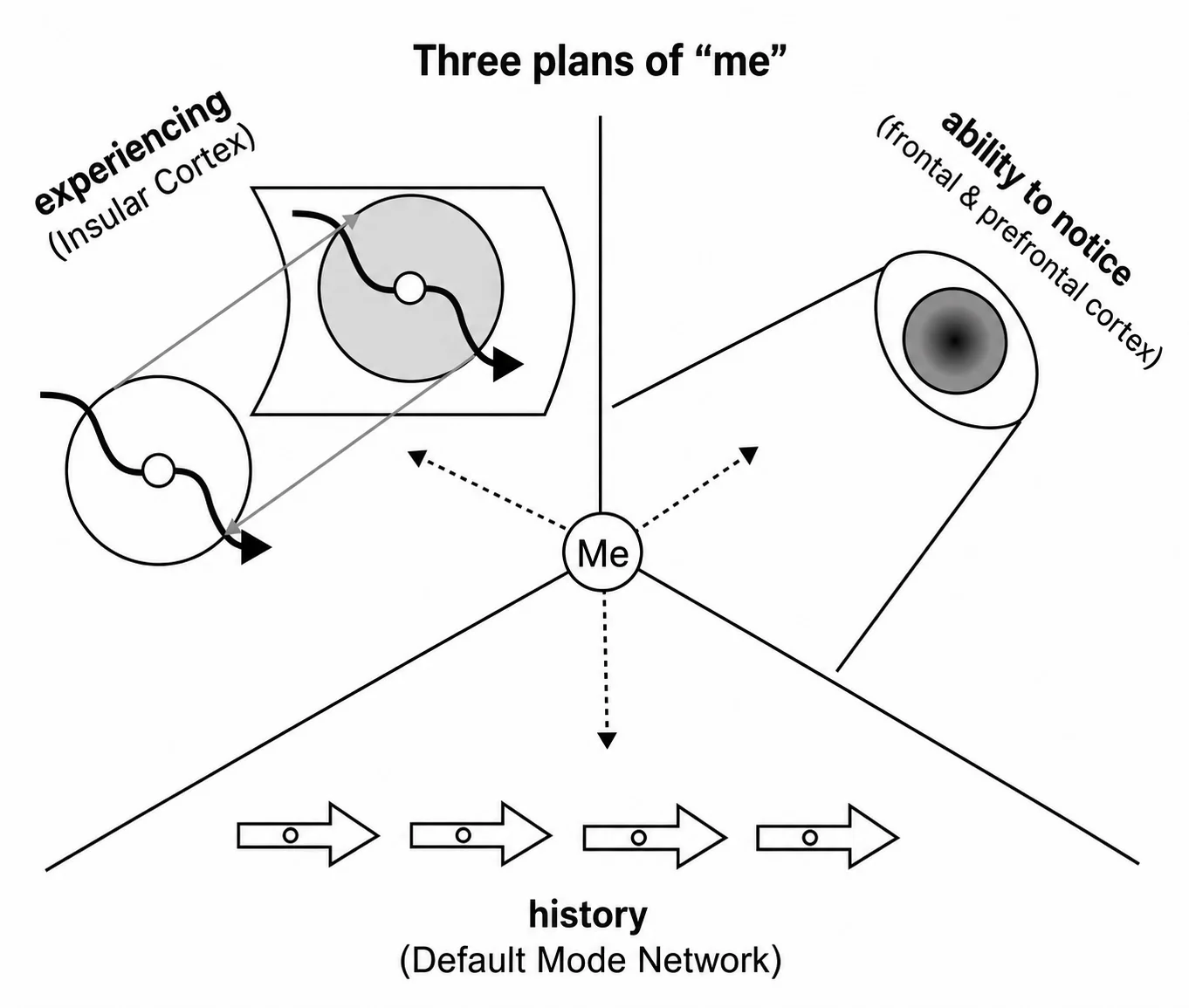
The collapse of familiar reality exposes the underlying architecture of human identity, which consists of three distinct layers:
- The Narrative "I": The story we tell about ourselves, our social roles, concepts, and the ego-structure generated by the brain's default mode network (DMN). This layer is the first to dissolve during crisis or transition.
- The Experiential "I": The raw, somatic marker of presence in the "here and now," localized within the insular cortex (insula).
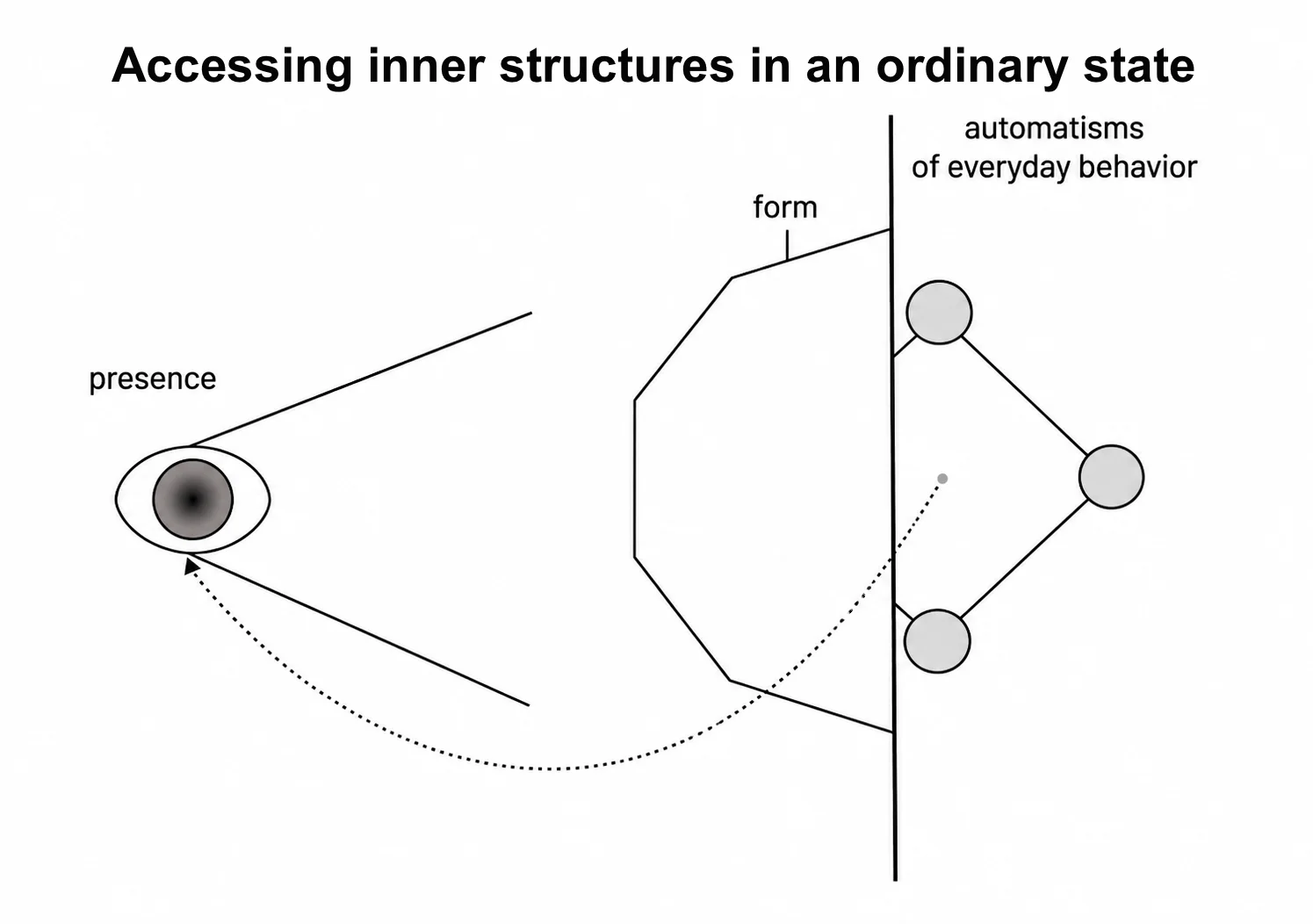
- The Axis of Distinction (The Metacognitive "I"): The pure function of witnessing—capable of observing the fading of both the narrative and the experiential layers. The book offers specific practices for anchoring attention within this axis.
The Orch-OR model suggests that neuronal microtubules act as detectors of quantum coherence, capable of interacting with the fundamental geometry of spacetime itself.
Within the context of relativistic physics—the "Block Universe" concept—past, present, and future exist simultaneously as a whole. The brain, therefore, does not generate consciousness, but acts as a biological reducer: a receiver that narrows an infinite, undivided reality for the sake of the body's survival. In this optic, death is the destruction of the receiver, allowing the localized signal to return to the ocean of the pure field.
For Those Seeking Understanding
For those who ask:
- What remains in me when the familiar supports crumble?
- What do I rely on when roles, achievements, and my old image of myself vanish?
- What have I actually been trying to preserve all my life?
- What part of me is impossible to lose?
Or even deeper:
- What remains of a phenomenon when the means of perceiving it disappear?
- What remains of a person when the familiar answers to "who am I" stop working?
- What remains of light when its radiance is extinguished?
For Those Seeking the Essence
For those who have noticed that life's most profound questions cannot be resolved through the accumulation of knowledge, wealth, achievements, power, or even spiritual experience alone.
For those who are not merely curious about how the world is constructed, but who are drawn to the deeper mystery: What makes the very experience of the world possible?
Language of the book
Key concepts
"Owl Optics" offers a clear language for describing complex inner states. These concepts help to see and gently embrace what usually eludes our attention.
01
Center
Our inner point of support. This is not an image of the "I" or the ego, but a living ability to experience any strong feelings, fears, or pain without completely dissolving in them.
02
Discernment
The main action of living consciousness. The ability to gently step back from overwhelming emotions, creating a caring space between yourself and the experience for choice.
03
Coherence
What holds the fragile elements of our life together without chaos or merging. It is much deeper than external form and endures even when that form collapses.
04
Pause (Presence)
The space of silence between an event and our habitual reaction. The ability to temporarily refrain from automatic action, where genuine freedom is born.
05
Limit
The point at which old explanations, familiar roles, and external landmarks finally cease to help, opening the door to deep and sincere exploration.
06
Field and flow
Two dimensions of our life. The field is the quiet, invisible space of possibilities where everything originates. The flow is how this experience unfolds and is lived by us over time.
07
Verticality
Our ability to rise above the present moment, interrupt the endless circling, and not be completely defined by our past or the accumulated inertia of trauma.
08
Tension and completion
The inner driving force. If emotional pain or an important life experience is not fully lived and completed, it inevitably returns to us in the form of compulsive repetitions.
09
Autonomy
The remarkable ability of a person to maintain deep inner integrity and coherence of feeling even when familiar external supports weaken or completely disappear.
10
Fusion
The initial living environment of our experience, where boundaries are not yet formed. A state in which we are completely absorbed in what is happening and do not yet separate ourselves from the surrounding world.
11
Inertia
The mechanical, unconscious reproduction of old grievances, defensive automatic reactions, and learned behavioral scripts without the living participation of our attention.
12
Immortality
The book's central question about the scale of preserving our inner coherence, warmth, and autonomy of consciousness during the physical destruction of its usual biological supports.
"Immortality does not begin after death.
It begins with the question of
what in a person is capable of maintaining coherence right now."
ORIGIN OF THE BOOK
Questions that led to the book
This book was not born from ready-made answers or dry lectures. It grew out of honest questions that cannot be definitively closed and from which one cannot hide behind habitual automatisms.
01
What remains unchanged within us when everything external collapses, slips away, and changes?
02
Can one face one's deepest fear and not lose oneself in it?
03
What exactly allows a person to maintain their inner center during moments of extreme life crisis?
04
Where is the thin invisible boundary between the emotional pain itself and the one who perceives and observes it?
05
What persists and continues to live within us if the most important, familiar support suddenly disappears?
06
How to reclaim genuine presence in the moment when the world around is rapidly pulling us into chaos?
07
What continues to operate beneath the surface and returns in the form of repetitions if inner tension has never been resolved?
08
What in a person is capable of passing through the very last limit without ever losing its coherence?
STRUCTURE OF THE BOOK
Three levels of perception
The book unfolds layer by layer. It is simultaneously a practical guide for those going through a life crisis, a profound philosophical inquiry, and a set of clear tools to help maintain mental clarity in the most difficult moments.
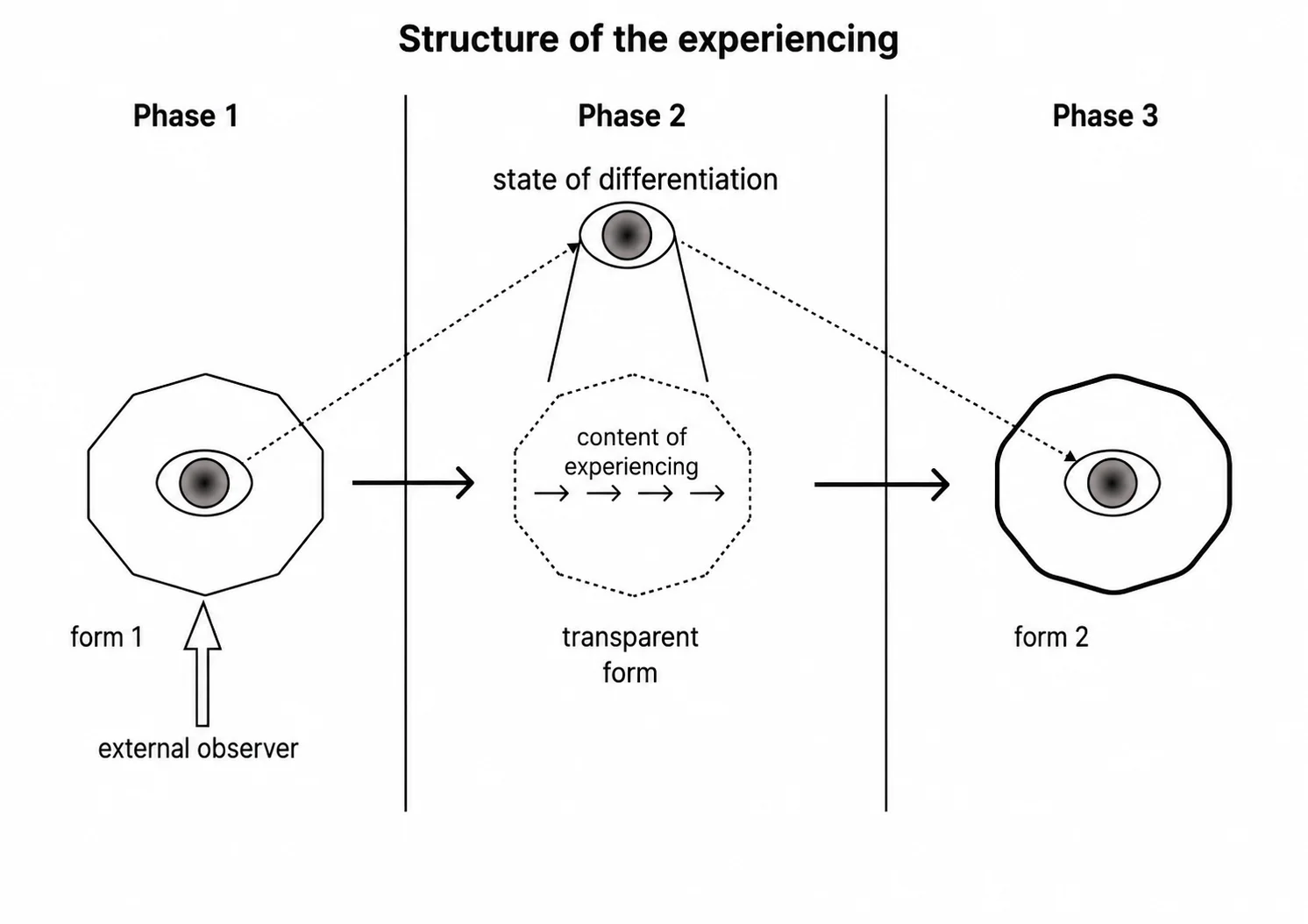
LEVEL 01
Practical
A anchor in moments of upheaval, uncertainty, and loss. The book shows how to go through life's crises with open eyes, maintaining inner stability, without running away from pain or hiding behind psychological defenses.
Maintaining the inner center
Working with fear and anxiety
Restoring wholeness
How to make choices in uncertainty
Living through complex emotions
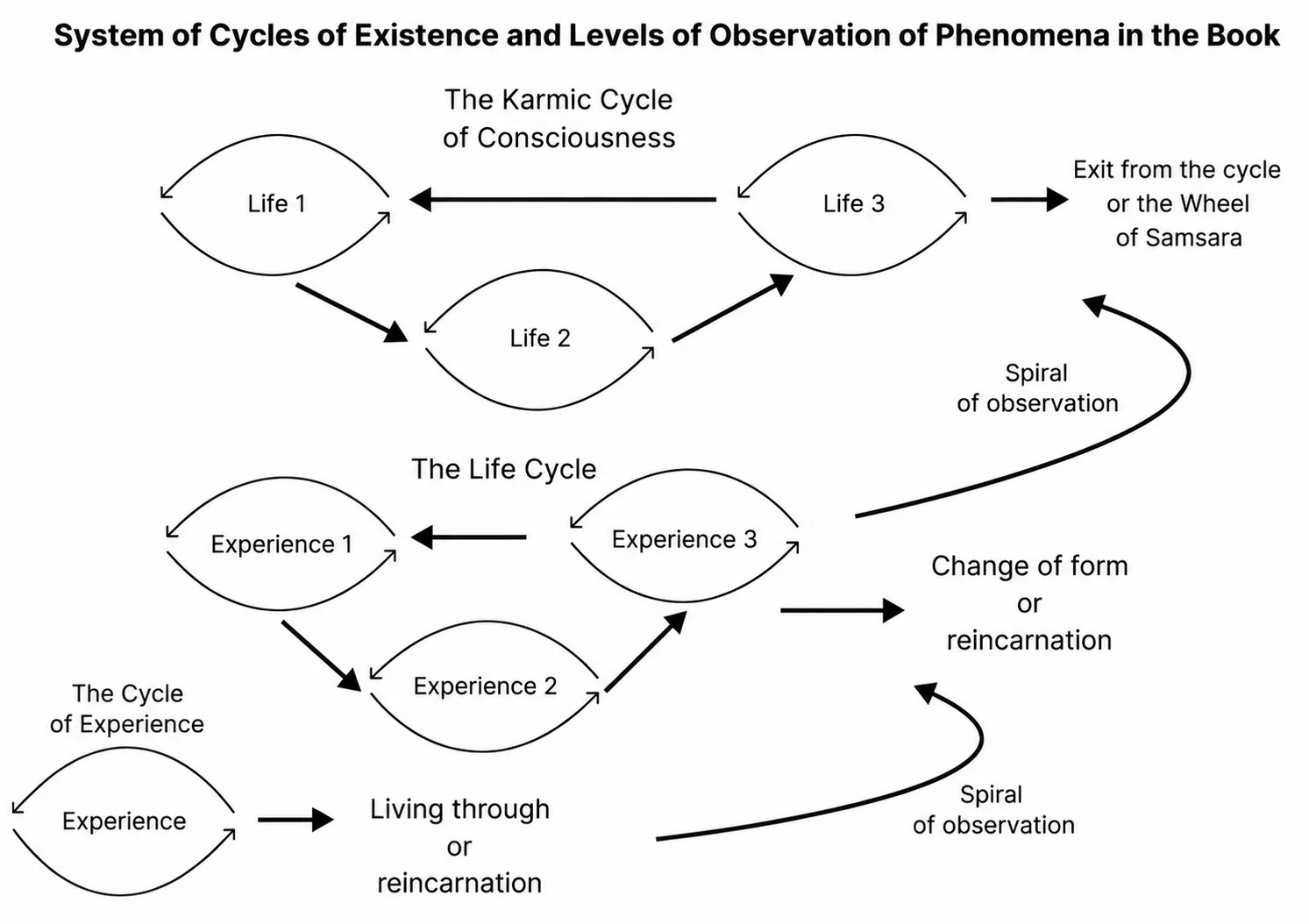
LEVEL 02
Philosophical
Searching for answers to the main questions. What happens to us when familiar roles and achievements disappear? What exactly in a person is capable of continuing when the external form of their life is destroyed?
The nature of our consciousness
The illusion of habitual time
What happens when form fades
Invisible connections between us
The true meaning of immortality
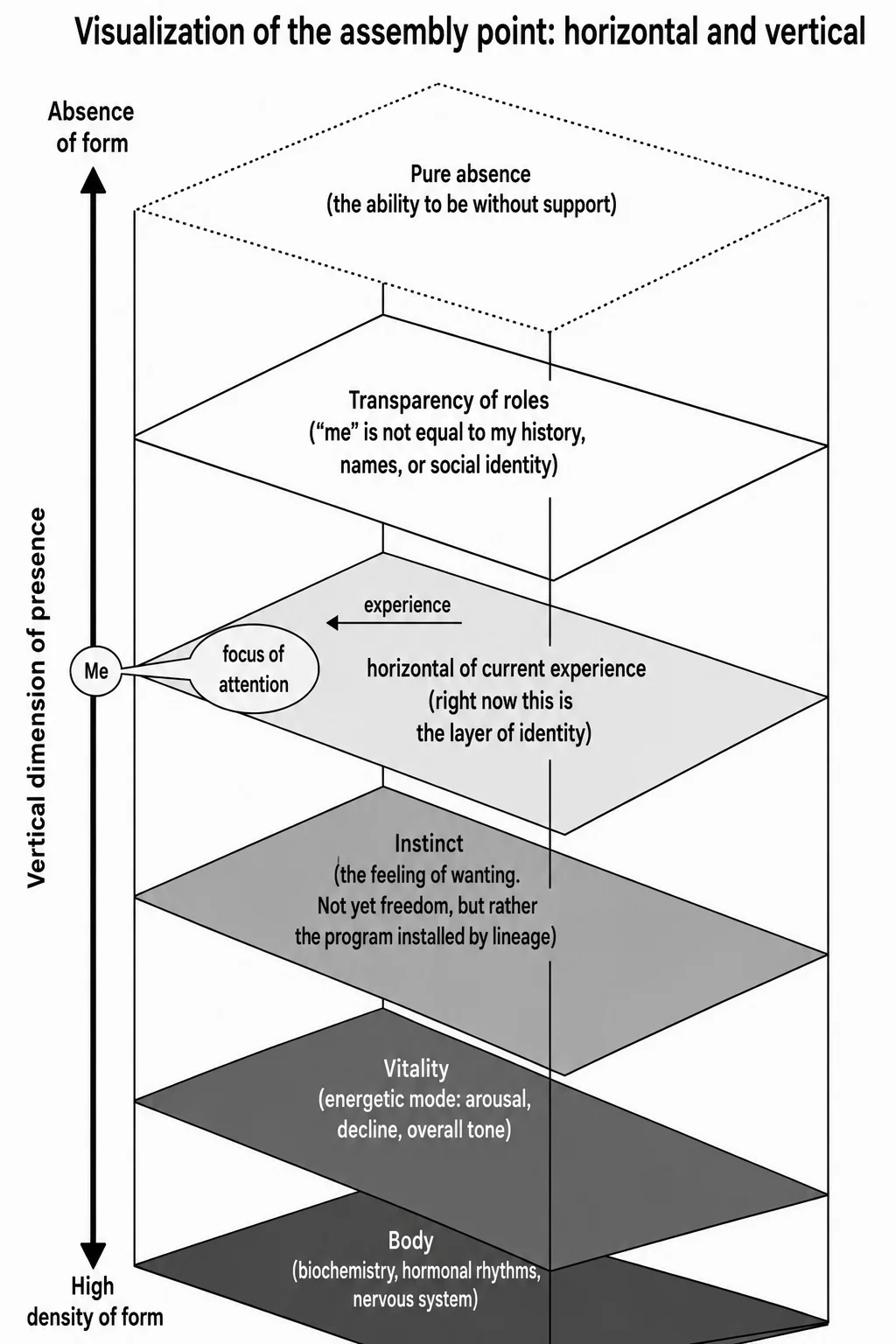
LEVEL 03
Instrumental
Tuning a new way of seeing things ("Owl Optics"). Clear tools that help maintain clarity and distinguish the essence where our habitual mind loses its bearings, becomes frightened, and goes blind.
Managing your own attention
The ability to notice the essence
Maintaining inner structure
Trusting the natural flow
Safely passing through the limit
"The book does not offer a ready-made belief. It offers a way of seeing."
The key paradox:
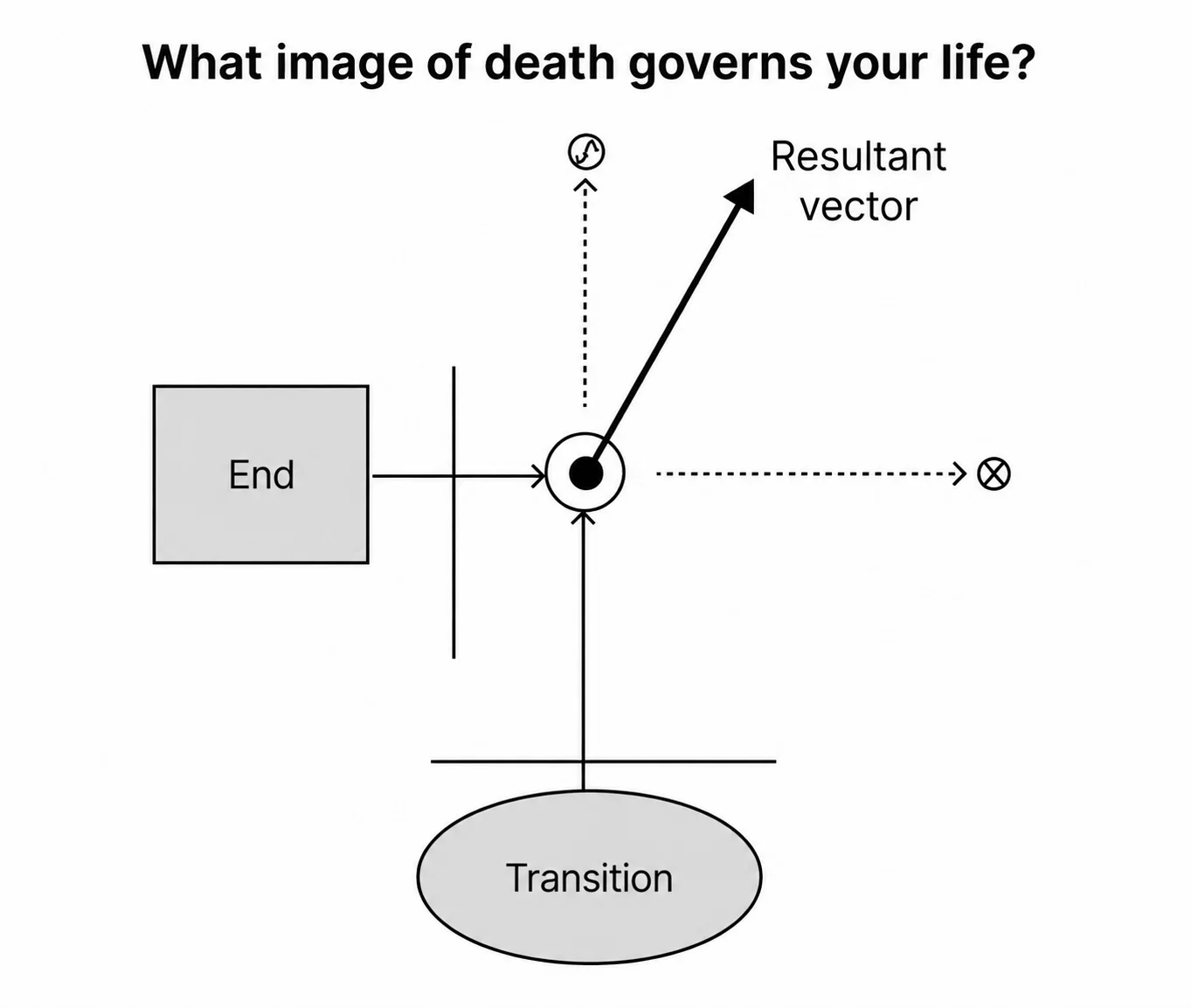
two absolutely polar images of the finale.
Most people live their lives with a hidden, false, externally imposed concept of the finale as passive decline. "Owl Optics" deconstructs this myth. There is a fundamental difference between the mechanical cessation of biological functions and the controlled phase transition of the Observer.
Explore the transition mechanics&
First image · Automatic
Death as destruction
A view through the prism of the ordinary ego-narrative. Perceived as chaotic disintegration of biological tissue, total disappearance of memory, darkness, and loss of control over one's own coherence.
Second image · Operational
Death as transformation
A view through the owl's optics. The limit as a technological challenge for the system of attention. A moment of highest synchronization of structures, where the pure Witness is freed from the framework of biographical form.
Synchronizing with archive holdings...
×
Archive cipher copied to clipboard.
Method Laboratory
Selected excerpts
Text copied to clipboard
Top